A Glimpse into the Future of Executive Decision-Making
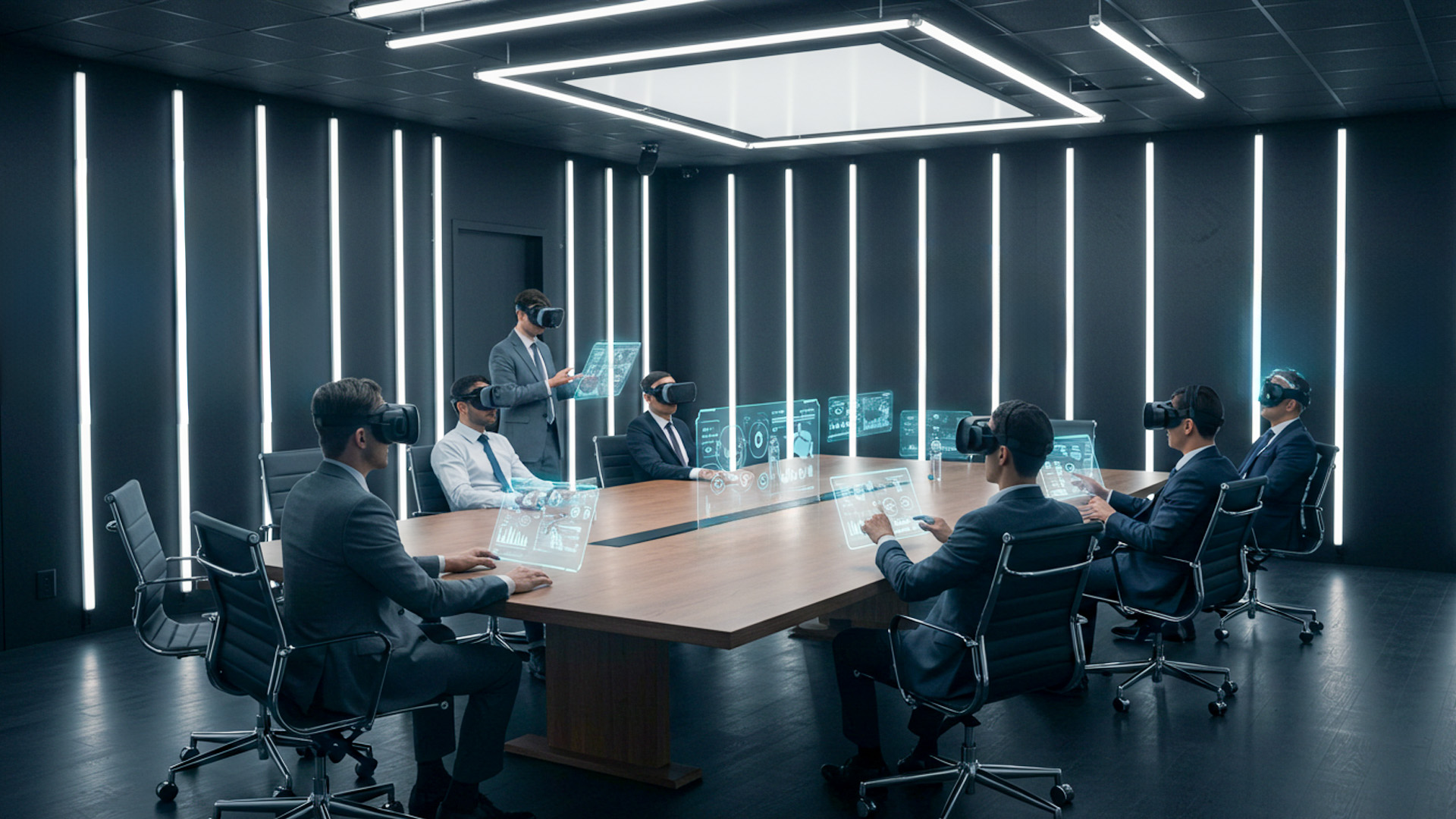
The boardroom has always been a theater of power—oak tables, glass walls, and carefully choreographed agendas. Yet by 2030, this stage will be transformed into a metaverse-driven arena where physical space becomes optional and digital presence reigns supreme. Imagine corporate leaders from five continents convening not through flat video feeds, but as photorealistic avatars in a shared virtual chamber that feels as tactile and authoritative as any skyscraper penthouse. This speculative vision is not confined to science fiction—it is built on emerging trajectories in haptics, brain-computer interfaces, and volumetric capture. In this article, we explore how these technologies will reshape the anatomy of high-level decision-making, offering a glimpse into the metaverse boardroom of tomorrow.
The Architecture of Presence
From Avatars to Digital Twins
By 2030, avatars will no longer be cartoonish caricatures but volumetric, AI-enhanced digital twins that mirror every nuance of expression and gesture. Executives will enter a boardroom where colleagues appear in three dimensions, rendered with such fidelity that distinguishing them from physical presence becomes a futile exercise. Each facial twitch, subtle hand movement, and posture adjustment will be captured through real-time volumetric scanning, ensuring the authenticity of nonverbal cues—those unspoken elements of communication that sway billion-dollar decisions. In this environment, “presence” will not be about geography but about bandwidth, processing power, and sensory immersion.
The shift to digital twins will also redefine hierarchy. No longer bound by who occupies the head of the table, the metaverse boardroom will be algorithmically configured to optimize visibility, voice distribution, and collaboration. AI systems will dynamically adjust seating positions, highlighting speakers or clustering relevant subgroups, eliminating the power plays of seating arrangements. In such a space, the currency of authority will not be proximity to the CEO but clarity of contribution and data-backed argumentation.
Haptic Walls and Tactile Tables
Touch will not vanish in a virtual world; it will be reinvented. Advanced haptic gloves and even full-body suits will render the polished surface of a digital mahogany table as convincingly as its physical counterpart. Executives will shake hands across continents, the sensation transmitted through force-feedback actuators that simulate grip, warmth, and subtle pressure. Boardroom artifacts—documents, financial reports, product prototypes—will be manipulable in mid-air, with haptic feedback simulating the weight of a binder or the smoothness of a prototype’s casing.
These tactile illusions will not simply provide comfort; they will enhance cognition. Research suggests that touch-based interaction strengthens memory retention and decision confidence. Thus, the metaverse boardroom will integrate haptic interactivity as a core design principle. Instead of pointing at pie charts on a screen, executives will literally grasp revenue segments, break them apart, and recombine them—turning abstract numbers into tangible objects of analysis. In doing so, data transforms from sterile figures into experiential knowledge.
Spatial Acoustics and Sonic Realism
Sound is the invisible architecture of presence. In the 2030 metaverse boardroom, spatialized acoustics will replicate how voices travel across real rooms. Each executive’s voice will carry location, depth, and timbre, ensuring natural conversational flow and eliminating the “flatness” of current conferencing tools. Real-time AI will filter out background noise while enhancing tonal subtleties, preserving the warmth of a chuckle or the weight of a pause. This sonic realism will make remote collaboration indistinguishable from in-person exchange.
Soundscapes will become programmable elements of corporate psychology. A boardroom may begin with ambient sound—subtle rustling leaves or flowing water—to foster creativity during brainstorming, then shift to minimalist silence for financial decision-making. Acoustic customization will act as an invisible moderator, tuning the emotional climate of the room to match the agenda. In this sense, audio becomes not just a medium of communication but a tool of governance.

Interfaces of the Mind
Brain-Computer Synergy
By the dawn of 2030, brain-computer interfaces (BCIs) will have migrated from laboratories into the executive suite. Instead of fumbling with controllers or keyboards, decision-makers will navigate the metaverse boardroom through thought-driven commands. A director needing a market projection will not ask aloud but simply think it, and an AI assistant will conjure holographic charts in seconds. This telepathic-like control streamlines cognitive flow, allowing ideas to leap directly from intention to visualization.
BCIs will also raise ethical and strategic dilemmas. What happens when thoughts stray? Will subconscious impulses be misinterpreted as intentional commands? To mitigate this, neural firewalls—AI filters that distinguish idle thought from actionable intent—will be embedded into corporate BCIs. These systems will guard against both cognitive accidents and corporate espionage, ensuring that what happens in the mind remains under the executive’s sovereign control.
Cognitive Load Balancing
The deluge of information in the boardroom of 2030 will exceed human working memory. Here, cognitive load balancing will become indispensable. AI systems will monitor neural activity via BCIs, detecting stress markers or overload signals. When executives near cognitive fatigue, the system will redistribute tasks: summarizing discussions, postponing non-critical data, or visualizing complex reports in simplified metaphors. In effect, the boardroom itself becomes a cognitive ally, dynamically adapting to human limits.
This balancing act mirrors how autopilot supports pilots in aviation—relieving them of routine strain while reserving attention for high-stakes maneuvers. Similarly, the metaverse boardroom will amplify human intelligence by stepping in when minds are strained, yet stepping back when creativity and strategic intuition are required. The result is a symbiotic loop where technology augments human decision-making without eclipsing it.
Silent Consensus Mechanisms
Imagine a vote where no hands are raised, no words spoken, yet consensus crystallizes instantly. Through BCIs, executives will be able to register agreement or dissent silently, their neural signals aggregated into a real-time consensus map. This reduces performative posturing and accelerates decision cycles, allowing boards to resolve contentious issues with unprecedented efficiency. Visual dashboards will render collective sentiment as glowing orbs, shifting color as agreement strengthens or fractures.
Such mechanisms could transform governance culture. Instead of debates dragged by egos or rhetorical dominance, decisions will hinge on authentic cognitive alignment. Yet, this efficiency carries risk: the disappearance of deliberative friction. Boards must safeguard against groupthink by embedding safeguards—forcing periodic verbal articulation of choices to ensure that silent consensus does not devolve into silent conformity.

Data as Living Architecture
Volumetric Data Sculptures
Spreadsheets and slides will feel archaic in 2030. Instead, corporate data will manifest as volumetric sculptures—pulsating, three-dimensional constructs suspended in the metaverse boardroom. Revenue streams may appear as glowing rivers; market share as shifting landscapes; consumer sentiment as weather systems swirling around the table. These immersive metaphors allow executives to step inside data, walking around it, probing it, and reshaping it like clay. The analytical becomes experiential, making complexity accessible through spatial interaction.
Beyond aesthetics, this approach enhances decision-making. By visualizing data as living architecture, patterns and anomalies become visceral experiences rather than abstract numbers. Executives can literally feel when markets tilt, sense when risks accumulate, and witness opportunities bloom in real time. In such a setting, intuition and analysis converge into a singular act of immersive reasoning.
AI Moderators and Narrative Builders
The boardroom of the future will be populated not just by human executives but by AI moderators. These agents will curate discussions, summarize positions, and construct real-time narratives that bind disparate threads into coherent strategies. Rather than poring over endless reports, leaders will receive story-driven synopses delivered with cinematic clarity, complete with visualized outcomes and risk pathways. The AI moderator becomes both narrator and analyst, weaving the data into meaning.
Narrative-driven decision-making introduces new vulnerabilities. Just as history has been shaped by storytellers, corporate futures may bend to the framing biases of AI narration. To counteract this, boards will appoint “narrative auditors”—human executives trained to interrogate AI framing, ensuring that persuasive storytelling does not obscure inconvenient truths. Thus, governance evolves not into blind trust in algorithms but into a dialectic between human judgment and machine narration.
Security Through Immersion
Confidentiality will be paramount in a world where intellectual property is both priceless and porous. The metaverse boardroom will embed immersive security protocols, from biometric authentication to continuous behavioral monitoring. Executives may enter only after multi-modal verification—retinal scan, voiceprint, and even neural signatures captured by BCIs. Once inside, encrypted environments will morph around them, ensuring that only authorized participants perceive sensitive content. A leak becomes nearly impossible, as data is rendered unreadable outside its intended perceptual context.
Yet, this heightened security will not merely be defensive. It will foster trust among globally dispersed leaders who must share trade secrets without fear of interception. In doing so, the metaverse boardroom becomes a fortress of transparency—a paradoxical space where openness is achieved precisely through impregnable immersion. Strategic candor thrives when confidentiality is guaranteed by design.

The Human Dimension of Virtual Governance
Rituals of Connection
The physical boardroom has always carried rituals—pouring coffee, exchanging handshakes, reading body language in the pauses between words. In 2030, these rituals will not disappear but adapt. Executives will gather for symbolic gestures coded into the metaverse environment: the digital passing of a “torch” to mark leadership transitions, or the synchronized pouring of virtual drinks to celebrate milestones. These rituals will provide continuity, anchoring corporate culture in a world where physicality is optional.
Such symbolic continuity matters. Without it, corporate governance risks becoming sterile—efficient but soulless. The metaverse boardroom will therefore embed intentional rituals to humanize its digital grandeur. These micro-gestures of belonging remind participants that behind every volumetric avatar is a human being negotiating not just strategy but shared identity.
The Psychology of Perpetual Presence
In a world where executives can convene at any hour without geographic friction, the risk of perpetual presence emerges. Leaders may find themselves tethered to always-available boardrooms, eroding the boundaries between strategic governance and personal life. The same technology that enables frictionless collaboration may also cultivate executive burnout. The allure of omnipresence—always being “in the room”—will demand new protocols for digital well-being.
Corporate policies will evolve to counterbalance this temptation. Mandatory disengagement periods, AI-enforced scheduling boundaries, and wellness algorithms monitoring stress will become as critical as financial audits. The boardroom of 2030 will not only orchestrate strategy but also protect the humanity of those steering it. Sustainability will extend from environmental to psychological domains, ensuring leaders thrive in both virtual and physical realities.
Ethics in a Post-Physical Arena
When the boardroom migrates to the metaverse, questions of ethics intensify. Should neural signals be used to infer honesty during negotiations? Is it appropriate for AI moderators to detect emotional states and influence decision pacing accordingly? These dilemmas will shape the moral compass of corporate governance in 2030. The potential for surveillance cloaked as collaboration demands explicit ethical frameworks, codified not as optional guidelines but as enforceable standards.
Boards will appoint Chief Ethics Officers tasked with auditing not just finances but the invisible architecture of digital governance. Their mandate: to ensure that the boardroom of 2030 amplifies human dignity rather than eroding it. In doing so, they will safeguard the most vital asset of all—trust. Without trust, no architecture of presence, advanced, can sustain meaningful governance.